

By Nicolas Jacobeus on April 2, 2026

Key Highlights
- Review management software helps businesses collect, manage, and leverage customer feedback at scale.
- The best platforms support automated review collection and multi-platform visibility.
- CRM-connected review management improves timing, response rates, and trust.
- Video and testimonial-based reviews are becoming core review management assets.
- This list compares the best review management software options for 2026.
- SaaSpirin ranks among the top options for scalable, high-quality review management.
Online reviews are no longer optional. In 2026, businesses are judged by how consistently they collect feedback, how transparently they showcase it, and how effectively they act on it.
Manual review collection and scattered platforms make it difficult to build trust and maintain credibility across channels.
This guide covers the best review management software available today, focusing on automation, multi-platform review management, customer feedback workflows, and scalability for growing businesses.
What Is Review Management Software?
Review management software is a system that helps businesses actively control how customer feedback is collected, organized, analyzed, and reused across channels. Instead of reviews living in silos or being handled reactively, the software turns feedback into an owned, repeatable process that supports trust, growth, and decision-making.
At its core, review management software moves reviews from something you monitor occasionally to something you operate strategically.
How Review Management Software Differs From Other Tools?
Many tools touch reviews, but they serve very different purposes. Understanding these differences matters because choosing the wrong category leads to fragmented feedback, missed insights, and underused social proof. Review management software stands apart by unifying control, context, and impact across the entire customer feedback lifecycle.
1. Compared to Google Review Monitoring Tools
Google review tools are designed to observe and respond to feedback on a single platform. Review management software goes further by unifying reviews from many sources and connecting them to workflows, insights, and reuse.
Key difference: Google tools help you protect your reputation on Google. Review management software helps you manage customer voice everywhere it matters.
2. Compared to Testimonial Software
Testimonial tools focus primarily on collecting positive quotes for marketing. Review management software handles the full spectrum of feedback, including neutral and negative reviews, and uses them to improve products, messaging, and experience.
Key difference: Testimonial software showcases trust. Review management software builds, measures, and compounds trust over time.
3. Compared to Social Proof Widgets
Social proof widgets display reviews on websites to increase conversions, but they rely on external sources and do not manage how reviews are generated or analyzed.
Key difference: Widgets amplify existing reviews. Review management software creates the system that produces, curates, and improves them.
What Changes When You Use Review Management Software?
When review management software is in place, reviews stop being reactive and fragmented.
- Feedback is collected intentionally, not sporadically.
- Teams respond faster and with more consistency.
- Customer sentiment becomes visible across the entire journey.
- Reviews are reused across marketing, sales, and product teams.
- Trust becomes a measurable, repeatable growth input.
In short, review management software transforms customer feedback from scattered signals into a strategic asset the business can actually act on.
Want to boost your SaaS growth with reviews? Learn how to leverage SaaS customer review sites for success and turn third-party feedback into increased visibility and conversions.
What Are the Key Evaluation Criteria for Review Management Software?
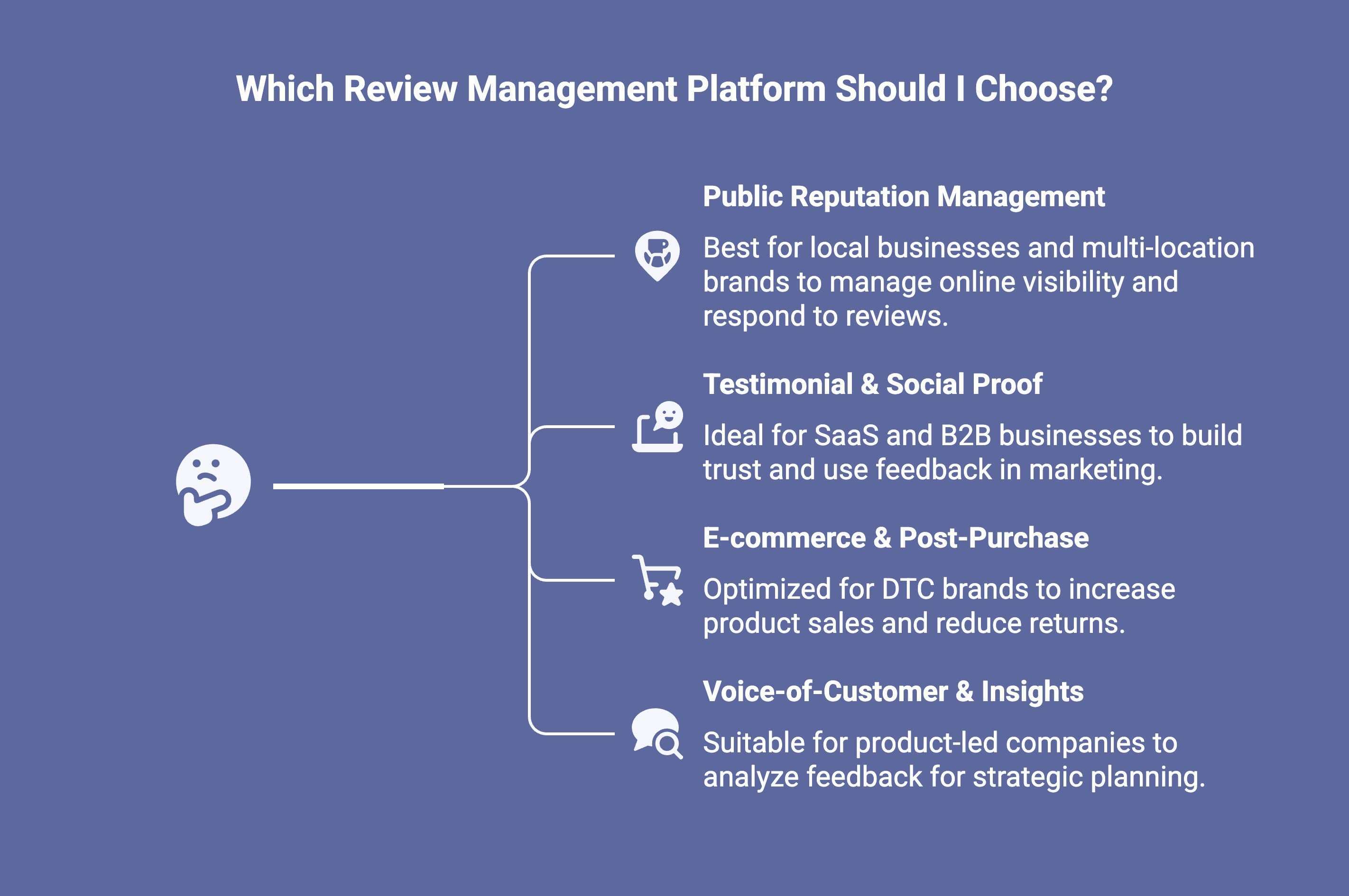
The biggest mistake businesses make when choosing review software is comparing feature lists. In 2026, most tools offer automation, integrations, and reporting. What really matters is what kind of review strategy the platform is built to support and how that aligns with your growth goals.
Below are the main types of review management platforms, what they enable, and who each is best suited for.
1. Public Reputation Management Platforms
These platforms focus on managing reviews where public perception directly affects demand, such as Google Business Profile, Yelp, Facebook, and industry directories. The strategy is visibility, responsiveness, and reputation protection.
Best for: Local businesses, multi-location brands, service providers, and franchises.
What this approach helps you achieve:
- Control brand perception across high-traffic public platforms.
- Respond quickly to negative reviews before they impact conversions.
- Improve local SEO and map pack performance.
When this is the right fit: If customer discovery happens through search, maps, or listings, and reviews influence foot traffic, calls, or bookings.
2. Testimonial & Social Proof Platforms
These tools are designed around collecting structured customer feedback and turning it into reusable proof across marketing and sales. The focus is not just collection, but activation.
Best for: SaaS, B2B, agencies, high-ticket service businesses.
What this approach helps you achieve:
- Build a steady pipeline of testimonials tied to outcomes.
- Turn customer feedback into conversion assets for landing pages, ads, and sales decks.
- Strengthen trust during longer buying cycles.
When this is the right fit: If reviews influence buying decisions during consideration, demos, or proposals rather than just discovery.
3. E-commerce & Post-Purchase Review Platforms
These platforms are optimized for volume, timing, and product-level feedback. Reviews are tightly connected to post-purchase flows and on-site conversion optimization.
Best for: DTC brands, marketplaces, subscription commerce.
What this approach helps you achieve:
- Increase product page conversion rates with fresh, relevant reviews.
- Collect high-volume feedback automatically after delivery or usage.
- Reduce returns by setting clearer expectations through customer insights.
When this is the right fit: If reviews directly impact product sales, repeat purchases, and trust at the point of checkout.
4. Voice-of-Customer & Insights Platforms
This category treats reviews as a data source rather than a marketing asset. Feedback is analyzed across channels to surface trends, risks, and opportunities.
Best for: Product-led companies, enterprise teams, CX-driven organizations.
What this approach helps you achieve:
- Identify recurring friction points and feature requests early.
- Align product, support, and marketing around real customer signals.
- Make customer sentiment part of strategic planning.
When this is the right fit: If your priority is learning, retention, and long-term customer experience optimization.
Looking to accelerate B2B purchase decisions? Discover advanced strategies for using case studies to reduce decision time and strengthen your sales impact.
What Are the Best Review Management Software Options in 2026?
Choosing the right review management software in 2026 is about more than collecting feedback. The best platforms help businesses automate review collection, centralize customer voices, and turn reviews into scalable trust assets that support marketing, sales, and long-term credibility across every customer touchpoint.
Below are the leading review management software platforms businesses are using in 2026.
1. SaaSpirin
SaaSpirin stands out in 2026 as a review management service built for quality, consistency, and long-term credibility. Instead of focusing only on automation, SaaSpirin offers a done-for-you approach that blends automation with professional execution. It captures authentic customer stories and delivers polished review assets without adding operational burden to internal teams.
Key Features
- Automated review outreach aligned with key customer lifecycle milestones to maximize relevance and response rates.
- Capture of authentic written and video reviews through guided, human-led interviews for higher credibility.
- Delivery of polished, high-quality review assets ready for immediate use across marketing and sales channels.
- Alignment with CRM-driven workflows to ensure consistent timing, context, and review activation.
- Scalable review management process that grows with customer volume without increasing internal workload.
Pros
- Done-for-you execution with minimal internal effort.
- High-quality output: professional videos + written stories.
- Includes subtitles and polished storytelling assets.
- Strategic focus on trust, credibility, and sales enablement.
Cons
- Not a self-serve review collection tool.
- Pricing is custom and tied to storytelling volume.
- Not focused on public review site monitoring.
- Not ideal for businesses needing high-frequency automated requests.
Pricing
- Launch $1,104/month (billed yearly): 6 customer stories/year.
- Growth $1,937/month (billed yearly): 12 customer stories/year.
- Scale $2,646/month (billed yearly): 18 customer stories/year.
Best For
- B2B and SaaS companies investing in high-impact customer stories.
- Teams wanting polished video + narrative testimonials.
- Organizations using reviews strategically in sales & marketing.
2. Birdeye

Birdeye is a well-established platform designed for businesses managing reviews across multiple locations and public review platforms. Its core strength lies in large-scale review monitoring, automated collection, and response management. Birdeye also provides analytics and local SEO insights, making it valuable for regionally distributed businesses.
Key Features
- Review monitoring across major public review platforms from a single centralized dashboard.
- Automated review request campaigns are designed to increase review volume consistently across locations.
- Response management tools paired with sentiment analysis and performance analytics.
- Local SEO and reputation insights to support visibility and credibility across regions.
Pros
- Centralized review monitoring across platforms
- Strong local SEO reputation tools
- Per-location analytics and sentiment insights
- Messaging and engagement tools included
Cons
- Pricing scales per location
- Less focus on storytelling and long-form testimonials
- May be too complex for smaller single-location teams
Pricing
- Starter: $299/mo. Review generation, basic SMS/messaging, business listings
- Growth: $399/mo. Adds social scheduling + AI engagement
- Dominate: $449/mo. Includes AI chatbots, advanced analytics
Best For
- Multi-location businesses.
- Retail chains, franchises, and clinics with regional presence.
- Organizations prioritizing public review management at scale.
3. Podium
Podium approaches review management with a messaging-first strategy focused on speed and convenience. Its SMS-based workflows make it easier for customers to leave reviews quickly, improving response rates in service-driven industries. Podium centralizes customer communication while integrating with CRM systems for better context.
Key Features
- SMS-based review requests are designed to capture fast feedback from customers immediately after interactions.
- Centralized inbox for managing customer messages, reviews, and responses in one interface.
- Review monitoring and response management tools that support consistent customer engagement.
- Integrations with CRM and core business systems to maintain a full customer context.
Pros
- SMS-first review capture increases response rates
- Unified inbox for messaging + reviews
- AI-assisted response and lead routing
- Excellent onboarding and phone system integrations
Cons
- Pricing not transparent (quote-based)
- Costs tend to scale with messaging volume
- Less emphasis on professional testimonials
- Review depth may be transactional
Pricing
Pricing for all the plans is available upon request.
- Core: Lead capture + reviews + basic automations
- Pro: Advanced AI automation + marketing workflows
- Signature: Multi-location, custom enterprise tier
Best For
- Service-based businesses
- Local companies with heavy SMS communication
- Teams prioritizing fast customer feedback loops
4. Yotpo
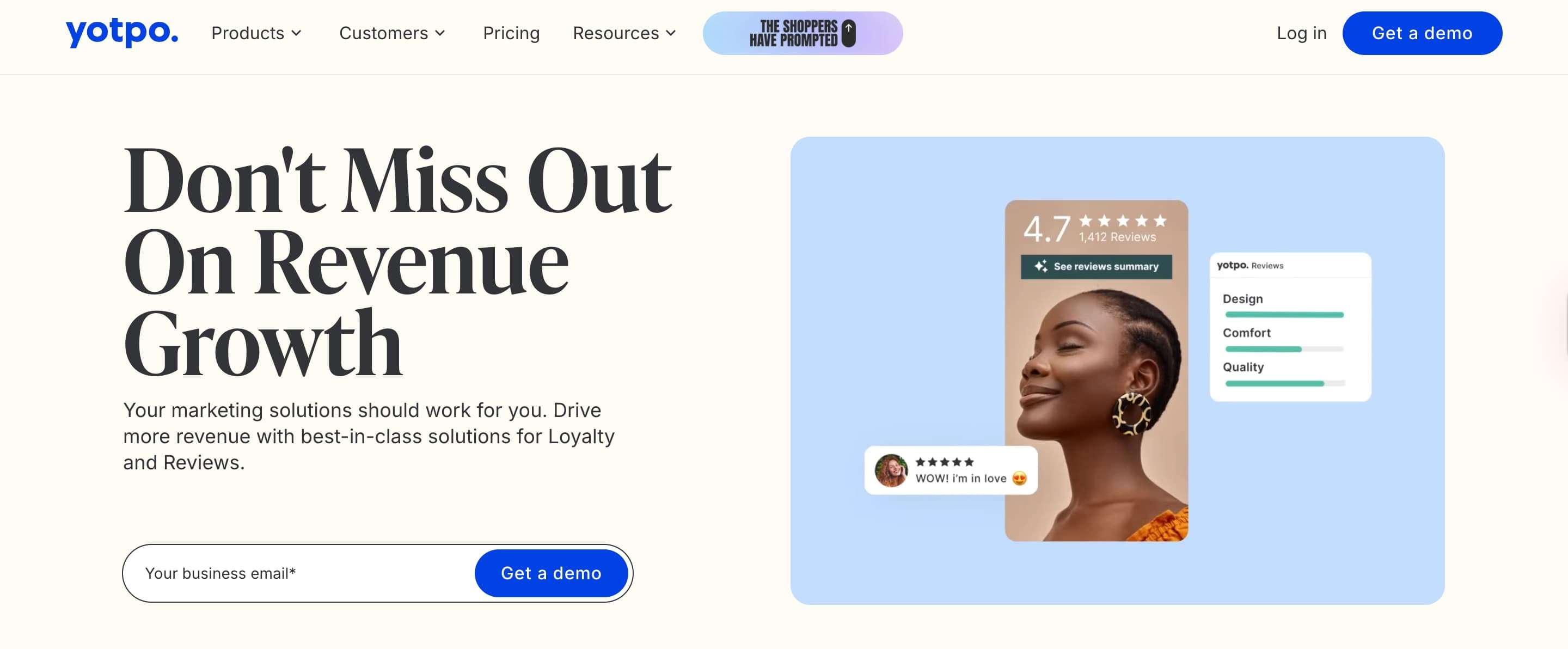
Yotpo is widely used by e-commerce brands to manage high volumes of product and site reviews efficiently. It automates post-purchase review requests and supports written, visual, and video reviews that strengthen product credibility. Yotpo integrates deeply with e-commerce platforms for seamless deployment.
Key Features
- Automated review request workflows are triggered immediately after customer purchases to increase review volume.
- Product-level and site-level review collection designed for large ecommerce catalogs.
- Support for visual and video reviews that enhance buyer confidence and conversion rates.
- Deep integrations with leading e-commerce platforms for smooth review collection and display.
Pros
- Designed for high-volume ecommerce review flows.
- Supports text, visual, and video reviews.
- Deep ecommerce integrations (Shopify, Magento, etc.).
- Improves on-site conversion with social proof displays.
Cons
- Not optimized for B2B or service industries.
- Costs scale with order volume and features.
- Can be complex for small shops with low order volume.
Pricing
- Starter: $79/mo- Up to 500 orders/month, basic tools.
- Pro: $169/mo- Adds seller ratings, AI features, 24/7 support.
- Premium / Enterprise: Custom pricing- Higher order volumes, insights, strategist support.
Best For
- E-commerce brands with frequent transactions.
- Stores needing strong onsite social proof.
- Retailers optimizing for conversion and reviews.
Curious why product testimonials really work? Find out why product testimonials are so reliable in building trust, improving credibility, and influencing buyer confidence.
What Does Multi-Platform Review Management Mean for Your Business in 2026?
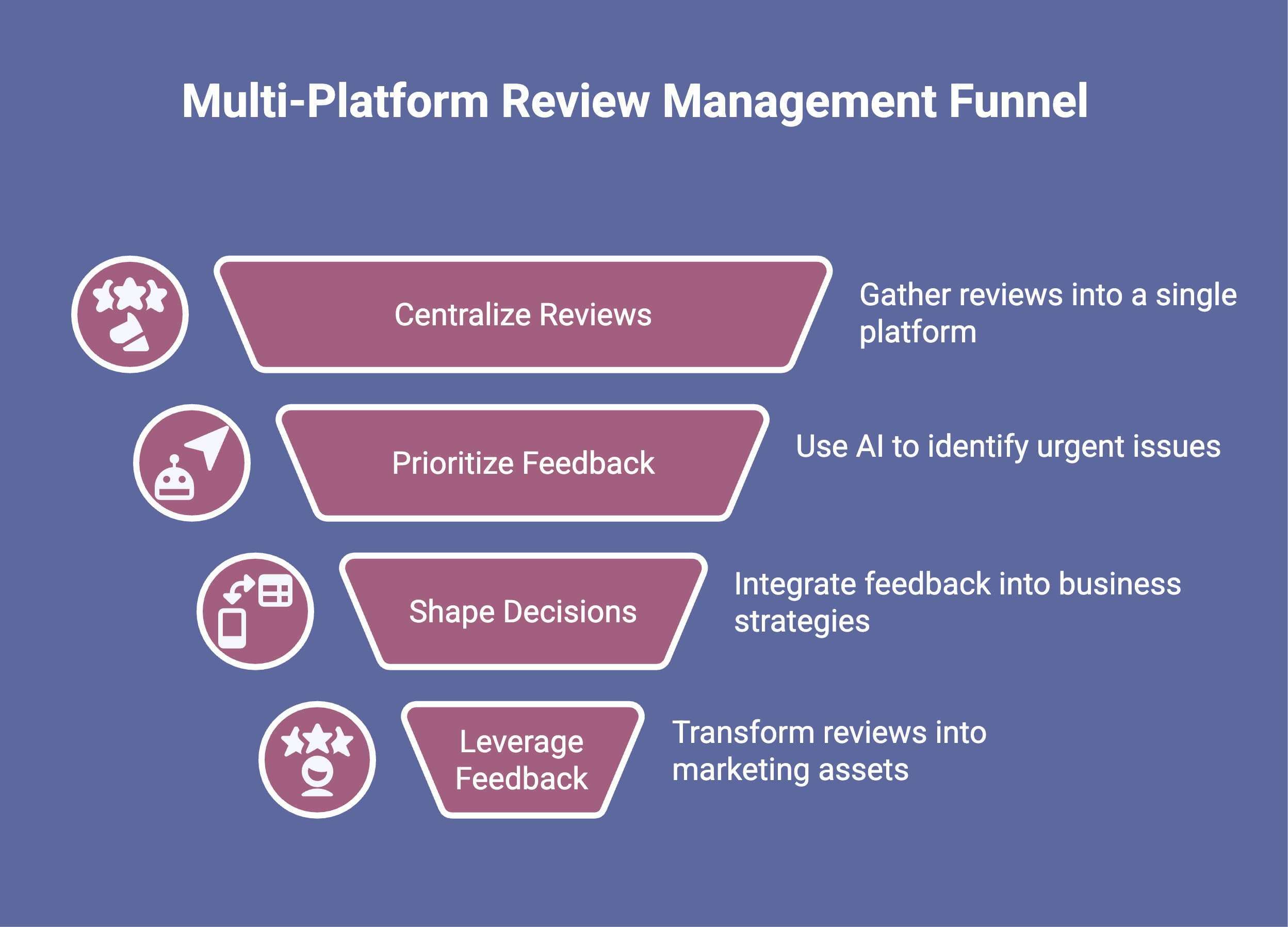
In 2026, review management is no longer an operational task. It is a strategic lever for growth, positioning, and customer intelligence. The goal is not to track reviews, but to use them to make faster decisions, protect revenue, and compound trust across every channel customers influence.
1. Owning the Full Customer Narrative
Customers now shape your brand across Google, G2, Capterra, Trustpilot, app stores, social platforms, and private communities. A multi-platform strategy gives you one source of truth for customer sentiment. Instead of reacting to isolated comments, you see patterns early and understand how your brand is perceived end-to-end, before issues escalate or opportunities are missed.
Outcome: Clear visibility into brand health, buyer trust, and reputation risk across the entire customer journey.
2. Faster Responses Without Team Friction
Modern systems centralize reviews into a single workflow so marketing, support, and success teams act in sync. AI prioritizes what matters most, flags urgent issues, and routes feedback to the right owners automatically. Review requests are triggered at high-impact moments, keeping feedback fresh without manual effort.
Outcome: Faster response times, fewer internal handoffs, and consistent brand voice at scale.
3. Feedback That Directly Shapes Decisions
Star ratings alone no longer drive value. Advanced review strategies surface recurring objections, product gaps, and differentiators across platforms. This intelligence feeds directly into product roadmaps, sales messaging, onboarding improvements, and retention initiatives.
Outcome: Reviews become a decision-making input, not just a reputation metric.
4. Turning Trust Into a Growth Channel
The most effective teams treat reviews as reusable assets. High-impact feedback is transformed into testimonials, ads, landing-page proof, sales enablement content, and social validation. In 2026, review management directly supports acquisition, conversion, and retention.
Outcome: Customer voices actively drive pipeline, not just protect brand image.
Final Thoughts
The best review management software in 2026 goes beyond monitoring and response. It automates collection, centralizes feedback, and transforms reviews into scalable trust assets that support marketing, sales, and customer success.
If your goal is long-term credibility and conversion impact, platforms like SaaSpirin and ProofFlow offer modern, CRM-aligned approaches to review management. The right choice ultimately depends on how deeply you want review management embedded into your customer lifecycle and growth strategy.
Frequently Asked Questions
What is the best review management software for businesses?
The best review management software centralizes customer feedback from multiple sources, such as Google, social media, and review sites, into one dashboard. It automates collection, tracks sentiment, and helps teams respond consistently to maintain a strong online reputation
What is automated review software?
Automated review software simplifies review generation by triggering requests after key customer interactions. It captures customer sentiment, reduces negative feedback handling time, and supports customer relationship management by organizing feedback throughout the customer journey without manual effort.
Do review management tools support video reviews?
Yes, modern platforms increasingly support video alongside Google reviews, helping businesses improve customer trust. Video content enhances brand image, builds emotional connection, and allows potential customers to evaluate authenticity beyond text-based feedback alone.
Why is multi-platform review management important?
Managing customer reviews across various platforms ensures visibility where customers search. A single dashboard helps monitor Google Business Profile activity, social media platforms, and third-party listings, improving ease of use while preventing fragmented data and inconsistent engagement.
Can review management software integrate with CRM systems?
Yes, integration enables syncing reviews with customer relationship management systems, connecting feedback to customer relationships. This alignment improves customer satisfaction by ensuring timely responses, contextual insights, and coordinated follow-ups across sales, support, and marketing workflows.
How can I manage Google Business reviews more efficiently?
Efficient management relies on Google My Business optimisation, structured review responses, and alerts for negative reviews. Automation helps teams protect online reputation management software performance while maintaining accuracy across locations and reducing missed engagement opportunities.
How do I get started with review management for my company?
Start by selecting a review management system that matches goals, auditing existing feedback, and defining workflows. Early focus on customer experience and consistency helps organizations improve customer loyalty while scaling structured reputation practices effectively.
Are there review management tools specifically designed for agencies?
Yes, marketing agencies benefit from tools offering multi-brand control, reporting, and scalable access. These platforms streamline managing online presence for multiple clients while delivering measurable value through standardized processes and centralized oversight.
How does AI-powered reputation management software improve online reviews?
AI analyzes customer interactions to extract valuable insights, prioritize issues, and identify patterns. This intelligence helps teams respond faster, resolve concerns proactively, and improve long-term outcomes without increasing operational complexity.
What are the pros and cons of different online reputation management tools?
Pros include visibility, automation, and analytics; cons may involve cost or learning curves. Tool choice impacts how local businesses influence potential customers, manage brand perception, and convert feedback into growth-driving actions consistently.

How to Leverage the Importance of Social Proof Effectively?
Accelerate Success: How to Shorten Sales Cycle?
.png)
